
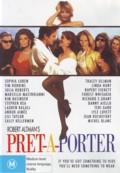
Directed by
Robert Altman
132 minutes
Rated G
Reviewed by
Bernard Hemingway

Pret-a-Porter
Prêt-à-Porter is the most extreme example of the distinctive style that Altman developed most famously with Nashville (1975) - a passing parade of characters loosely organised into a narrative and represented by a roster of screen stars. Here the form is stretched to breaking point – the relationships are numerous, the narrative loose to the point of being diarrhoeal and the cast list of famous actors and famous celebrities is positively stellar. How exactly Altman gets away with this freewheelin' farrago defies understanding but his reputation as an iconoclast has made him an actors’ favourite. But equally he needs to keep favour with an audience and this film is likely to challenge even his most devoted fans.A satire about the world of haute couture. the film has its mildly amusing moments, largely thanks to some of the performance such as Richard E. Grant’s foppish designer and his clandestine relationship with the burly Forest Whitaker, but the film is more often than not akin to a drunken ramble. The main narrative axis, reminiscent of a 1960s Continental comedy, concerns the search for the supposed killer (Marcello Mastroianni in a droll performance) of the head of Paris’s Fashion Week. A smaller sub-plot involves Tim Robbins and Julia Roberts holed up in a hotel room because they have lost their baggage. Frankly the latter is the only part of the film that I found engaging as at least it had some attempt to create a genuine relationship between its characters. As for Teri Garr and Danny Aiello's Woody Allenish escapade, forget about it. The rest of the film is devoted to a lot of high profile actors camping it up in one guise or another. Not too badly at that but proceedings are needlessly protracted by long crowds scenes involving celebrity-peppered before and after parties and so on, none of which amount to anything but a slight diversion.
That lack of narrative form and dramatic focus seems to be Altman’s point – that is, he is wilfully rejecting the conventions of filmed story-telling. But he also appears to be wanting to satirize the world of high fashion and the informality of the first aim undermines the second with no compensatory benefit. All you can do is wonder what he and his co-producers were thinking.

Want something different?


