
Directed by
George P. Cosmatos
132 minutes
Rated M
Reviewed by
Bernard Hemingway

Tombstone
As the opening and closing voice-overs by one-time screen cowboy Robert Mitchum with their extracts from silent era Westerns and references to the first screen cowboys, Tom Mix and William S. Hart, Tombstone is more about the Wild West of the big screen than it is about its realities.
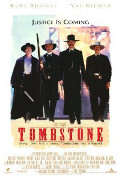
Retelling for the umpteenth time the infamous gunfight at the O.K Corral the film is part good guys/bad guys face-off, part Victorian costume drama with the Earps (played by Kurt Russell , Sam Elliott and Bill Paxton) and Doc Holliday (played by Val Kilmer) looking very smart in their tailored duds up against “the cowboys”, a predatory lot of ne’er do wells that include the Clantons, they who, with exception of brother Ike (Stephen Lang), a career coward, ended up corpses after the abovementioned gunfight. Historically the gunfight only lasted 30 seconds and as it occurs approximately half-way through the film, a good deal of time is spent on displaying the boom era West with their gambling dens and gaudy theatres, endowing Wyatt Earp with a romantic interest in soubrette Josephine (Dana Delany) and then turning him into a man bent on retribution for the death of his brother Morgan and crippling of Virgil.
The screenplay by Kevin Jarre has a distinctly mordant tone to. It’s not just the usual quota of senseless killings such as that of the old town marshall (played by John Ford veteran Harry Carey Jr) early in the film but Doc Holliday is willfully drinking himself to death, Wyatt’s wife (Dana Wheeler-Nicholson), is addicted to laudanum and opium use is apparently rife whilst the leader of the cowboys Johnny Ringo (Michael Biehn) is a Latin-spouting nihilist whose murderous ways are driven by a desire for "revenge for being born". The film even manages to include an unhappy homosexual (Jason Priestley) with a crush on Josephine's stage partner.
All this is given a treatment that is both top drawer and misguided in its lavish staging (Jarre started to direct the film before being replaced by Cosmatos and his scenes with Charlton Heston at the film’s end are much leaner). This sort of thing works well with Roaring Twenties/Depression era gangster films where conspicuous consumption is the order of the day but here it simply drowns the classic Western yarn with production values that leave Russell, Elliott and Paxton doing little more than supporting their widescreen mustaches.
To be fair, the staging of the gunfight at the O.K. Corral is probably the best to date and Kilmer is a lot of fun as the fin-de-siècle gambler but the women are no more than token presences, even Delany’s Josephine, is curiously unengaging and her affair with Wyatt remains more notional than actual.

Want something different?


