
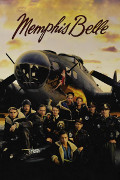
Directed by
Michael Caton-Jones
108 minutes
Rated PG
Reviewed by
Bernard Hemingway

Memphis Belle
Michael Caton-Jones’s film was generally disparaged at the time of its release as Chariots of Fire with wings, a reference to producer David Puttnam's 1981 critical and commercial success that won the Best Picture Oscar that year.
It tells the story of the final mission of the B-17 bomber Memphis Belle from a U.S. Army Air Force base in England to Bremen in the German heartland. Whilst failing to achieve the same kind of emotional persuasion as Chariots (which owed much to Vangelis’s score), surprisingly the film is better than you might expect.
The actual raid which constitute a substantial portion of the film is quite well done (although when they enter the target zone it is apparent that back projection is being used) with a good sense of the privations and dangers involved in such missions. War film buffs will enjoy the primitive hardware and the old school combat scenes in the blue empyrean with blazing machine guns and planes bursting into flames.
The rest of the film however suffers badly from a lack of conviction with the first third given over to a parade of young actors including Matthew Modine, Eric Stoltz, Billy Zane, and jazz musician Harry Connick Jr.(who gets to croon 'Danny Boy' which also turns up in the film’s climactic and ridiculously over the top finale) amongst others who are all distractingly good-looking but to a man completely uninteresting as they earnestly project their ideas of brave, fun-loving young flyboys who know that they could die tomorrow. So self-conscious are they with their bomber jackets and stylish haircuts that at times the film plays like The Breakfast Club (1985). John Lithgow as a witless public-relations officer and David Strathairn as a sternly caring C.O. are pressed into action to give the film some dramatic force but Monte Merrick's toothless script simply pastes together a welter of genre clichés.
Designed as a homage to the airmen who gave their lives in WWII, whilst acknowledging the innocent civilians who also died in such raids, the film gives at best token attention to them (Modine’s captain is at pains not to bomb a school so that takes care of moral compromise). Thus although the end-titles tell us that 200,000 airmen died during WWII there is no mention of equivalent civilian numbers.
A marquee film for both Modine and Stoltz who had been gradually building a presence through the 1980s ironically it represented a career peak for both of them who have been been busy as jobbing actors ever since.

Want something different?


