
Directed by
Bob Rafelson
103 minutes
Rated M
Reviewed by
Bernard Hemingway

Black Widow
The 1980s were the decade of sexually threatening women (Fatal Attraction came out the same year as Rafelson’s film) and as the title amply suggests, Black Widow amply fits the bill.
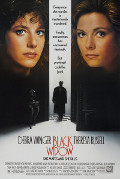
Debra Winger plays a work-obsessed Federal Justice department investigator, Alex, who picks up the scent of murder when two men die of a rare respiratory disease, Ondine’s Curse, both who had much younger wives. Alex suspects foul play and becomes convinced that the wives were the same woman. The woman in question is played by Theresa Russell who was pretty much your go-to girl in the 1980s when it came to sexually-calculating women. The issue is not did she do it but how Alex is going to prove it. After a yet another husband, a wealthy Seattle art collector (Nicol Williamson), is bumped off surprisingly, Alex’s bosses still show no interest in her theory so Alex sells up everything she owns and tracks the woman to Hawaii where she befriends her in a last ditch effort to entangle her in her own deadly web.
As a production, Black Widow is a typical mainstream ‘80s thriller, all glossy visuals with characters with big hair and big shoulders, living the high life to the accompaniment of a synth-based score, etcetera, etcetera. The plot is essentially nonsense, blithely sketching a story that transpire over a period of some years that are conflated with absolutely no concern to explain the enabling mechanics (indeed most of the actual events happen off screen).
What makes the film passably interesting, although it remains largely unrealized, is the eroticized relationship between the two women. Russell is well suited to the role of the sexually-alluring but psychotic, killer whilst Winger provides a girl-next-door winsomeness that makes for a tantalizing dynamic between the two. Unfortunately this largely falls by the wayside in the final act in which in a fatiguing turn of events Russell’s character picks out a fourth victim (Sami Frey) with whom Alex also falls in love. The final act completely tosses plausibility out the window for a big (heterosexual) justice-is-seen-to-be-done ending.
Despite the promising neo-noir resonances of its title, and unlike Nicolas Roeg’s Bad Timing (1980) which also explored the dark side of sexual obsession and in which Russell had also starred, Black Widow fails to engage with the potential of its material. The result is a ho-hum affair that deserved to be better. And don't be misled by Dennis Hopper's name in the credits. He's onscreen for a few minutes and to no particular effect.

Want something different?


