
Directed by
Vittorio De Sica
62 minutes
Rated PG
Reviewed by
Bernard Hemingway

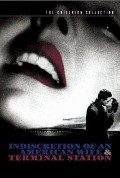
Indiscretion Of An American Wife
Vittorio De Sica's first English language film, Stazione Termini with dialogue by Truman Capote was later re-cut by its producer David O. Selznick, notorious for his obsession with the onscreen appearace of his wife and star of the film, Jennifer Jones, and released as Indiscretion Of An American Wife.
The title is the best thing about a film which is a misalliance between De Sica's neo-realist and Selznick's Hollywood aesthetics. At just over 62 minutes (after Selznick had cut it to 58 minutes he inserted a couple of songs by Patti Page to eke out the running time) it is essentially a series of painful farewells set to a florid musical accompaniment leading to a final (and literally painful) anti-climatic parting as Jones, the wife of the title, reluctantly quits her erstwhile Italian lover, played by Montgomery Clift, at Rome’s Termini Station,
Clift was part of the James Dean school of troubled young men and hardly exudes Latin machismo (in real life he was gay), making him an unlikely pairing for Jones’ sophisticated married woman unless one sees in the relationship some kind of displaced mother-son relationship. This interesting possibility is not, however, paralleled by Jones’ rather proper character who is regularly reminded of her daughter back home and does not apparently suffer from Clift’s neurotic dependence. (In the De Sica version she is far less the dutiful-but-briefly-gone-astray housewife and exhibits a more overt sexuality that Selznick left on the cutting-room floor but that still doesn’t explain her attachment to Clift). As it stands, Indiscretion has some interesting visual and tonal aspects typical of Italian neo-realist cinema of which De Sica was a leading figure although there is far too much interpellation of Fellini-esque stock characters – the boy scouts, priests, soldiers and peering and leering Italian males and so on. Casting issues aside, the character's passionate confusion does exude a certain charm but the film is probably at best an interesting cultural contrast to the most famous of all filmed railway station romances, David Lean’s very proper Brief Encounter (1945).
FYI: Producer Selznick, working in Europe in order to access monies tied up from Gone With The Wind had done similarly with Powell and Pressburger's Gone To Earth, 1952, having some of it re-shot by Rouben Mamoulian and releasing it as The Wild Heart)

Want something different?


