
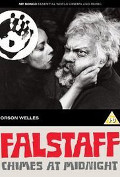
Spain/Switzerland 1965
Directed by
Orson Welles
115 minutes
Rated PG
Reviewed by
Bernard Hemingway

Chimes At Midnight
Although hailed in some quarters as a masterpiece those quarters must be largely peopled by desperate poseurs wanting to reserve for themselves the artistic high-ground. For everyone else, despite recognizing that it is a handsome production with striking cinematography by Luis Buñuel’s regular cameraman Edmond Richard, Chimes At Midnight, a Spanish-Swiss co-production, will be a near incomprehensible exercise in the Shakespearean manner so beloved by director Orson Welles.The script is a loosely-connected and largely incomprehensible compendium of scenes and characters largely taken by Welles from Shakespeare's "Henry IV, Parts 1 and 2" and built around the rotund figure (Welles again) of its central protagonist, Sir John Falstaff, and his adventures as a member of the English court in the early 1400s. Its incomprehensibility results in part from the piecemeal nature of the assemblage approach but more grievously from the fact that it is virtually impossible to understand what anyone is saying. This in turn is in part due to the prolixity and antique nature of the prose, but also because the dialogue track which seems somehow severed from the image track and pitched at some level below or obliquely to it. It appears to be in synch and its audible but it’s not comprehensible. Even such a noted thespian as John Gielgud who plays the unhappy Henry IV comes off badly ad whilst Welles revels in the role of Falstaff, he comes across more as a medieval buffoon than the gamey boon companion to Prince Hal (Keith Baxter) and jolly roustabout that Welles presumably wanted him to be.
For all its merits as a production, and that there are as many as there are is somewhat of an achievement in the director's roller-coaster career, in the final analysis Chimes At Midnight is a misfire and if you’ve been attracted to it by the glowing critical enthusiasm for it be prepared to suffer for Welles’s art.

Want something different?


