
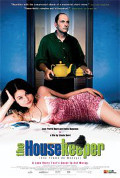
France 2002
Directed by
Claude Berri
89 minutes
Rated M
Reviewed by
Ruth Williams

Housekeeper, A
Synopsis: Jacques (Jean-Pierre Bacri) doesn’t care much for cleaning. Since his wife left him, he has found little reason to keep a tidy house. However the months are passing and not a surface in his house is left uncovered. When he sees an advertisement for a housekeeper in the local bakery, he decides it is time to clean up his life. Laura (Emilie Dequenne) is young and carefree and it is not long before her infectious nature rubs off on Jacques. The sweep of Laura’s broom removes more than just cobwebs and Jacques’ life looks like it is about to have a serious spring clean.Claude Berri is probably best known by the majority of film-goers for his 1986 feature Jean De Florette. Approaching his seventieth birthday in 2004, in this film Berri provides his audience with a maturity of vision that comes from having lived a long life. The older characters here are all suffering from their own versions of loss or loneliness. It is as if they consider this to be their lot in life. Inviting Laura to become his housekeeper shows that Jacques has a desire to re-direct the propulsion of his life away from an eternity of solitary meals and the reading of legitimate literary tomes.
The unusual combination of Jacques and Laura offers us an interesting proposition, when two people who seemingly have nothing in common find themselves caught up in a strange desire, where will their dalliance lead them? The difference in age is portrayed cleverly in the way in which Laura is willing to try anything while Jacques has a host of good reasons not to participate. Much as children draw their parents out of the encroaching passivity of middle age, Laura will not accept his desire to spend the rest of his life sitting in a chair with a good book.
The film is marketed as a romantic comedy for sophisticated moviegoers. The humour is gentle and the romance fleeting but the combination of these factors results in a film that is worthy of our consideration. Jacques is not the stereotypical older man lusting for a younger lover out of a need to prove his masculinity. His resistance to the lure of Laura’s nubile ways (Dequenne, who first came to attention in the very different Rosetta is well-cast in this respect) will to some extent assuage the reservations of those who mightfind it overly indulgent of a male fantasy that is particularly endemic in French film.
One of the casting choices I found most interesting is the choice of Catherine Breillat as Constance, Jacques’ wife. Breillat hasn’t acted in a film since the 1970s (her first role was as small part in Last Tango In Paris, 1972) Her most recent public face is as a director, with her 1999 feature film, Romance, raising eyebrows with its frank exploration of a woman’s sexual journey. Does this mean the film’s theme has her seal of approval? Who knows, but it does give us that bit extra to think about. It is certainly not a confrontational film but as a portrait of our eternal need for love, it has a melancholy charm.

Want more about this film?


Want something different?


