
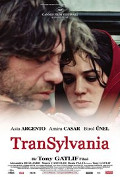
Directed by
Tony Gatlif
103 minutes
Rated M
Reviewed by
Bernard Hemingway

Transylvania
Synopsis: Zingarina (Asia Argento) has travelled to Transylvania is search of her gypsy musician lover, Milan (Marco Castoldi) to whom she is two months pregnant. She thinks he was deported but when she finds him he tells her that he doesn’t love her and that he was not deported as she thought, but rather ran away from her. Distraught she hits the road where she meets a two-bit rag-and-bone man Tchangalo (Birol Unel) who takes her under his wing.
Algerian-born and France-based writer-director Tony Gatlif won everyone’s heart with his 1993 documentary-cum-road movie overview of gypsy music, Latcho Drom. Since then he has been revisiting particular aspects of that journey in the form of fictional stories that showcase the various regional musical and cultural styles – Spanish flamenco in Vengo (2000), Django-style jazz in Swing (2002). With Transylvania he returns to the distinctively frenetic style of Eastern Europe. Recalling his 1997 efffort, Gadjo Djilo, which starred Romain Duris and Rona Hartner, once again we have a couple of misfits (Argento and Unel) passing through the landscape to the accompaniment of song and dance.
As much as we have loved the music of his films, Gatlif’s formula with its pointed celebration of gypsy joie de vivre in the face of hardship has gradually worn thin and with Transylvania it is close to threadbare. Even more, the joy seems to be overtaken by disaffection as we travel through a miserably cold, sodden landscape from one dirt-poor village to the next to the accompaniment of a kind of demented fairground music which here comes across more as a desperate solace than an outpouring of enthusiasm for life. Emir Kustarica has done this sort of material much better, notably in his wonderful 1988 film, Time Of The Gypsies, perhaps because his stories are of the people themselves rather than two outsiders passing through.
Whilst the central problem of Gatlif’s film is the absence of any dramatic substance, the grubby wastrels that are the two leads are also off-putting. Argento spends so much time being sullen or screeching that one can well understand why her boyfriend lammed out whilst Unel, whom one will recall from Fatih Akin’s 2004 film, Head-On, is a cheap hustler whose life is a never-ending attempt to con the villagers out of their pathetic possessions so that he can get money to get drunk. Clearly the two are supposed to be misfits who find a communality in their estrangement but Gatlif is unable to give us any reason to sympathize with them or find their story remotely interesting or for that matter plausible (how could a pregnant woman live out of the back of a station-wagon for seven months, let alone in freezing temperatures!). La Strada (1954) this is not. There are moments when the film captures us visually such as when Tchangalo rigs up a chandelier to light the campsite, and under a blanket of snow the Transylvanian landscape often looks beautiful, but overall there is simply not enough here to sustain one's interest.

Want more about this film?


Want something different?


