
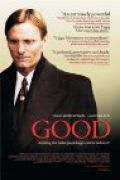
Directed by
Vicente Amorim
92 minutes
Rated M
Reviewed by
Sharon Hurst

Good
Synopsis: John Halder (Viggo Mortensen) is a professor of literature in Germany in the 1930s.He is basically a decent guy but his life is fraught –wife Helen (Anastasia Hille) barely copes with life, and his senile mother (Gemma Jones) is constantly making demands. John confides regularly in his Jewish shrink and ex-army pal Maurice (Jason Isaacs), and also happens to write a novel exploring the concept of compassionate euthanasia. In the late 1930s his novel comes to the attention of higher-ups in the Third Reich and they co-opt him into writing academic propaganda supporting policies aimed at getting rid of disabled people. What they ask of John will increase as the war progresses.Films like Good often create a stir – some viewers get quite agitated, believing the films to be apologist and making excuses for the nightmare that was Nazi Germany. Yet this plot, taken from a stage play by C.P. Taylor, presents quite a cogent scenario, of how a basically good person gets caught up in something way beyond his imagining. It also examines how the initially small role John takes on gradually spirals – do a job for a promotion, and then the next and so on, until he finds himself inextricably caught up in the Nazi ethos, with devastating consequences. Good can perhaps be seen as an allegory for the rise of Nazi Germany, and how many people got swept up in the political fervour, and only woke up too late to the nightmare they had created.
Adapting theatre to film is always a challenge, and to the credit of Brazilian director Amorim and Belgian screenwriter John Wrathall, they create a well-paced and tense story, with enough good dialogue and action to thoroughly engage. Scenes of the burning of proscribed books at the university are well staged, while later, anti-Jewish riots and concentration camp scenes invest it with the required sobriety.
Carrying much of the film are the excellent performances, firstly by Mortensen who makes a departure from recent roles to play a far more reflective person than his usual man of action. It’s a tricky task to keep us sympathetic towards John, yet the actor achieves it.
The strongest scenes in the film are those between Maurice and John. Isaacs (best known as Lucius Malfoy in the Harry Potter films) is powerful as the proudly German psychiatrist who believes he’s immune since he fought for his country, like so many other Jews did, in World War One. As the anti-Semitic persecution heats up, Maurice is reduced to begging John to help him. These crucial scenes between the old army pals are tense and emotional, and as always an audience is implicitly invited to speculate on “what would I have done?”
The questionability of John’s “goodness” also comes into play with the love affair he has with one of his students, Anne (Jodie Whittaker). He believes he’s done the right thing waiting until she is no longer his student, and he always continues to care for his mother, Helen and the children. However I find Helen’s strangely passive acceptance of John’s infidelity somewhat hard to believe. The sultry glamorous Anne will ultimately prove to be John’s undoing in a way that will bring him face to face with the nightmare of betrayal and death that has overtaken his life.
Some aspects of the film are too self-consciously “stagey”, such as when Halder thinks he hears people breaking into song, and I fail to see why these were included. But overall, as an addition to the now-extensive Holocaust catalogue, I found this film worthy, forcing us all to reflect on what we might do under similar circumstances.

Want more about this film?


Want something different?


